

Signs the repair money has run out
Most air conditioners that get replaced never died in one dramatic night. They wore down through a string of service calls: a capacitor one summer, an outdoor fan motor the next, a refrigerant top-off that kept coming back. At some point the honest answer stops being another part and starts being new equipment, and you should hear that from someone who has also told plenty of owners to keep their old unit running.
Age counts, but it is one input among several. A fifteen-year-old system with a sound coil and a healthy compressor can deserve another repair. A ten-year-old one with a leaking evaporator coil and a compressor drawing high amps may not. Brian looks at the coil, the compressor, the repair history and what your power bill has been doing, then prices the repair and the replacement side by side so the comparison sits in front of you.
Sometimes the right call is to keep the old unit going a while longer. You will hear that when it is true.
Questions that usually settle it
Has the compressor or the indoor coil failed? Is this the third or fourth repair in a few summers? Does the system still run on R-22, the older refrigerant that is no longer produced? Has the power bill crept up with no change in how you live? A yes to two or more is worth a replacement conversation.
- Load calculation before any equipment is chosen
- Package or split, matched to the house
- Duct connections inspected and sealed
- Two or three options with running costs compared
- System measured at startup, before anyone leaves
The wider service is described on our AC replacement page, and finished installs are in the gallery.
Package unit or split system: follow the house
Read what is already there
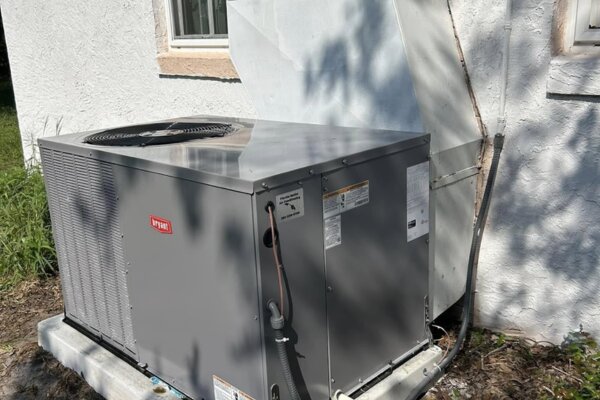
Many manufactured homes and plenty of site-built ranch houses out here run on a package unit: one cabinet on a pad beside the house holding the compressor, both coils and the blower, with ducts passing through the wall or under the floor. Other homes have a split system, with a condenser outside and an air handler in a closet, garage or attic. The replacement usually follows the original type, because the ductwork, the wall openings and the electrical feed are already set up for it.
Check the pad and the connections
A package unit needs a level, solid pad, and the duct collars where the cabinet meets the house are a common spot for air to escape. Those get inspected and resealed as part of the swap. On a split system, the line set, the condensate drain and the disconnect get the same scrutiny.
A new unit bolted to leaky duct collars cools the crawlspace and the yard along with the living room.
Change the type only for a reason
Moving from a package unit to a split system, or the reverse, can make sense when a house has been added onto or the old equipment location keeps causing trouble. It also adds cost. If switching would not solve a real problem in that particular house, the recommendation stays with what the house already has.
Around Basinger, from the same shop
- Emergency AC repair
A dead system on a hot night, answered by the owner.
- Ductless mini-split installation
Zoned cooling for rooms the central system never reached.
- Heat pump repair
Reversing valves, defrost faults and heat strips doing too much work.
- Refrigerant leak repair
Locating the leak, then deciding between a fix and a new coil.
For the town overview, see the Basinger page; for every place we cover, open service areas.
Send Brian the JobTonnage starts with the house itself
The quickest way to size a replacement is to read the old unit’s data plate and order the same tonnage. It is also how a lot of homes end up with the wrong system twice. The original may have been oversized on the day it went in, and the house has probably changed since: new windows, added attic insulation, a closed-in porch, a bedroom wing built on.
A load calculation works from the building instead. Square footage, ceiling heights, insulation, window area and the direction those windows face, how much shade falls on the roof, how many people live there. The result says how much cooling the home needs on a hot, humid afternoon. An oversized unit chills the air fast and shuts off before it pulls the moisture out, so the house feels cold and clammy at once while the equipment wears itself out on short starts. An undersized one runs all afternoon and never quite catches up.
Drying the air is half the job
In this climate a cooling system earns its keep by removing moisture as much as heat. Correct sizing, a blower speed set for dehumidification and a tight return side let a house feel comfortable at a higher thermostat setting, and that higher setting is where the operating savings come from.
The ducts get a look too
New equipment pushing air through crushed or disconnected duct runs underperforms from the first day. Where the ducts can be reached, they get checked before any equipment is chosen, and repairs are priced separately so you decide what to take on.
Real choices, each with its running cost
A replacement quote from Florida Native arrives as a short set of options. Often that means a dependable single-stage system, a higher-efficiency model, and sometimes a variable-speed unit for owners who care most about humidity control. Each one comes with its price and a plain explanation of how its summer operating cost compares with the others, so you can weigh the upfront number against the power bill over the years you plan to stay in the house.
Rheem and Trane are the factory relationships here, which brings preferred access to equipment and parts plus technical support when an install calls for something out of the ordinary. If your Goodman or Carrier is healthy, you hear exactly that, and the replacement quote stays in the folder.
Every option carries the 100% satisfaction guarantee, and the person who quotes it is the owner, with twenty years in the trade, who answers for it afterward.
How install day runs
The crew arrives at the time you agreed on. The old unit is shut down, its refrigerant recovered, and it leaves on the truck. The new equipment goes onto a level pad, the connections are sealed, the wiring is checked against the nameplate, and the system is started, charged to the manufacturer’s numbers and measured before anyone calls it finished. You get a walkthrough of the thermostat and the filter slot on the way out.
Want the choices on paper first? Send the model number and age of your system and the conversation can start there.
What Basinger owners ask before replacing
Not seeing yours? 561-339-5729 reaches Brian any time of day.
How do I know replacement beats another repair?
Look at the failed part, the system’s age and its repair history together. A compressor or coil failure on an older unit usually tips toward replacement, while a capacitor or fan motor on a sound system usually does not. You get both prices next to each other and make the call yourself.
Should a manufactured home keep a package unit?
Usually, yes. The ducts, wall openings and electrical feed in most manufactured homes are built around a package unit sitting on a pad outside. Switching to a split system is possible, but it adds cost and work, so it only makes sense when it fixes a specific problem in that home.
Can you just match the size of my old unit?
Matching the old tonnage repeats any sizing mistake from the original install and ignores everything that has changed in the house since. A load calculation measures what the home actually needs today. Sometimes it lands on the same size, and sometimes it shows the old unit was too big all along.
Do I have to switch to Rheem or Trane?
No. Those brands carry factory backing here, so they often suit a new install well, and the recommendation still follows the house and the budget. Nobody will push you to replace a working system from another manufacturer just to change the name printed on the cabinet.
What happens to my old unit?
The refrigerant is recovered with proper equipment before anything is disconnected, as federal rules require, and the old cabinet leaves with the crew. You are not left with a rusted unit sitting beside the house or a hauling job to arrange on your own afterward.
Is a higher-efficiency system worth it out here?
Often, because cooling runs most of the year in this part of Florida. The operating cost difference between options is laid out in the quote, so you can see how long the efficiency upgrade takes to pay for itself in your house over the years you expect to stay.
Line up the options before it fails
Replacing a system on your own schedule beats replacing it on the hottest night of the year. Send the model number from the data plate, the rough age of the unit and what it has been doing lately. Brian will set a visit, measure the house and come back with real choices.
Schedule Service